Asansör Nedir Ve Tarihçesi
An elevator is a lifting system designed to transport people and goods between different levels. It consists of a suspended carrier that travels along rigid guides inclined at an angle of more than 15 degrees to the horizontal. Historical documents indicate that elevators, which we now use as an essential means of vertical transportation, first spread from Europe to the rest of the world.
From ancient times through the Middle Ages, up to the early 13th century, lifting devices were powered by humans and animals. Historical inscriptions reveal that the palaces of the Roman Empire had compartments that moved between floors.
In a work written in AD 26, the Roman architect Vitruvius mentioned devices used in Rome to raise and lower loads as early as 236 BC. Scholars later identified these compartments as primitive elevators.
During the Middle Ages, similar lifting compartments are known to have operated along the exterior walls of monasteries. These elevators are believed to have been built primarily for defensive and protective purposes, preventing enemies from entering during nighttime raids.
In the early 17th century, a French architect named Velayer improved this primitive device by adding a counterweight to provide better balance. Operated by turning a mechanism by hand, it became known as the “flying chair.” Fifteen years later, the American architect Henry Waterman built a larger compartment and used it in a two-storey building. By operating the device with compressed air, he demonstrated that human power was no longer necessary.
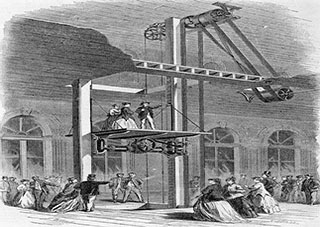
In 1867, a French engineer named Edoux built a new lifting machine for the Paris International Exhibition and called it an “ascenseur.” This machine carried visitors up to the highest point and brought them back down. At the Paris Exhibition in 1878, Edoux succeeded in lifting passengers to a height of 62.5 metres. In 1880, the German physicist Werner von Siemens introduced another innovation by using electricity at the Mannheim Exhibition. At an exhibition held in Paris in 1889, the renowned French engineer Eiffel also installed an elevator in the tower that immortalised his name, allowing visitors to ascend effortlessly and enjoy views of Paris.
Just three years later, in 1892, the Pera Palace Hotel was built in Istanbul by the French architect Alexandre Vallaury to accommodate passengers travelling on the Orient Express. Located in a city steeped in history, the hotel overlooks the captivating beauty of the Golden Horn.
Besides being the first building in Beyoğlu to use electricity, the Pera Palace Hotel also houses Türkiye’s oldest electric elevator, dating back to 1892. Occupying one of the hotel’s most beautiful corners, this century-old elevator has become an integral part of Pera Palace. It has preserved its beauty and grandeur to this day, rivalling even modern elevators. With a capacity of five passengers, or 400 kg, the elevator receives weekly maintenance and an annual inspection. Operated by a lift attendant, it has reportedly experienced no major accidents throughout its long history—a source of pride for this century-old installation.
Exactly fifteen years later, in 1907, a Jewish citizen named Nesim Levi commissioned an elevator in the Karataş district of İzmir, the pearl of Türkiye’s Aegean region. Built particularly to assist elderly people and people with disabilities, the elevator initially operated using steam power and now runs on electricity. This structure became İzmir’s historic elevator tower. Standing 60 metres tall, the tower contains two elevators with a travel distance of 55 metres. The elevators, which had remained out of service until relatively recently, have since been renovated. At the top, a café and restaurant offer visitors a place to relax and enjoy the outstanding views of İzmir Bay.
In the years that followed, numerous elevators were installed, particularly in Istanbul’s Beyoğlu district. Unfortunately, many of these historic elevators disappeared during building alterations or when older buildings were demolished and replaced.
At the beginning of the 19th century, technological advances in elevators gathered momentum worldwide. Major international companies were established, bringing about a technological revolution in the elevator industry.
Today, elevators are built that travel at speeds of eight metres per second and reach heights of up to 400 metres. These intelligent elevators can comfortably carry 20 to 25 passengers.
To briefly explain intelligent elevators, these systems are designed around a building’s passenger traffic. Their automation systems can even monitor passengers’ usage patterns. For example, when a passenger regularly uses the elevator from a particular floor, the system can recognise this pattern after a few days and have the elevator waiting on that floor.
Most importantly, in the event of a hazard, the system uses the information stored in its database to determine which floors should receive priority. Once an elevator reaches full capacity, it travels directly to its destination without stopping at other floors, reducing unnecessary delays. When equipped with an uninterruptible power supply (UPS), these elevators can also avoid becoming stranded between floors during power outages or generator failures.